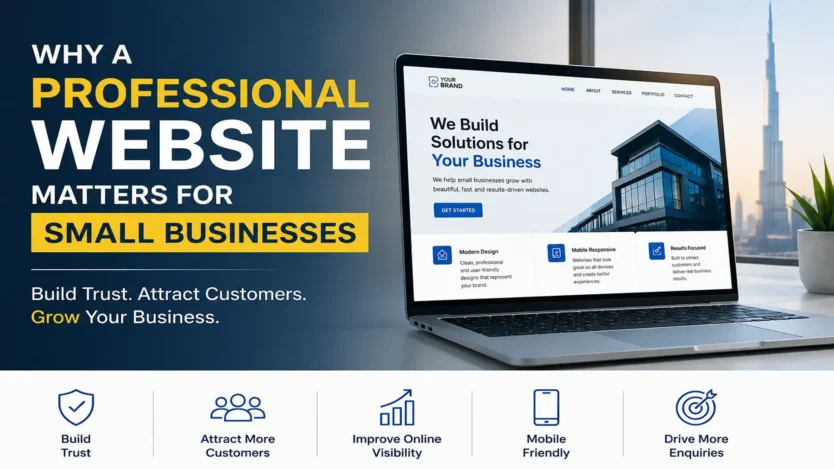
For many small businesses, a website is no longer just an online brochure. It is often the first place a potential customer checks before calling, visiting, or making a purchase.
A professional website helps your business establish credibility, explain your services, generate enquiries, and compete with larger companies. On the other hand, an outdated or poorly designed website can quickly reduce trust and cause potential customers to leave.
This guide explains what makes a website effective and what small businesses should consider before investing in web design.
1. Your Website Creates the First Impression
Customers often judge a business within seconds of opening its website.
A clean, professional design immediately communicates that the business is established, trustworthy, and attentive to detail. A cluttered layout, slow-loading pages, broken links, or outdated information can create the opposite impression.
Good website design should make it easy for visitors to understand:
- Who you are
- What products or services you offer
- Who you serve
- Why customers should choose you
- How they can contact you
The goal is not to make a website unnecessarily complicated. The best small-business websites are usually simple, clear, and easy to navigate.
2. Mobile-Friendly Design Is Essential
A large percentage of website traffic now comes from smartphones.
If your website looks good on a computer but is difficult to use on a mobile device, you may lose potential customers before they even explore your services.
A mobile-friendly website should have:
- Responsive page layouts
- Readable text without zooming
- Easy-to-tap buttons
- Clear menus
- Fast-loading images
- Simple contact forms
For local businesses, mobile usability is especially important because customers may be searching for services while travelling, shopping, or looking for a nearby provider.
3. Website Speed Can Affect Customer Decisions
Visitors expect websites to load quickly.
When a website takes too long to open, many users leave and visit a competitor instead. Website speed can also influence search engine performance.
Several factors can slow down a website, including:
- Oversized images
- Poor-quality hosting
- Too many plugins or scripts
- Heavy animations
- Unoptimized code
- Poor caching configuration
A professional website should therefore be designed with performance in mind from the beginning rather than trying to fix speed problems later.
4. Clear Navigation Improves User Experience
Visitors should not have to search through multiple pages to find basic information.
A typical small-business website may only need a few important sections, such as:
Home
A clear overview of the business and its main services.
About Us
Information about the company, experience, approach, and values.
Services
Dedicated information about each service offered.
Portfolio or Projects
Examples of completed work where relevant.
Contact
Phone number, email, enquiry form, WhatsApp link, location, or business hours.
Depending on the business, additional pages such as FAQs, testimonials, pricing, blogs, or product pages may also be useful.
The navigation should reflect what customers actually want to find.
5. Good Web Design Supports Search Engine Visibility
Having a website does not automatically mean customers will find it on Google.
Search engine optimization, commonly known as SEO, helps search engines understand your website and determine when it should appear in relevant searches.
A well-structured website creates a stronger foundation for SEO through:
- Logical page structure
- Clear headings
- Descriptive page titles
- Relevant service pages
- Fast loading speeds
- Mobile optimization
- Internal linking
- Useful content
- Proper image optimization
For small businesses, local SEO can also help attract customers searching for services within a particular city or area.
For example, a business may benefit more from appearing for a specific search related to its service and location than from trying to rank for a very broad keyword.
6. Your Website Should Encourage Visitors to Take Action
A business website should have a clear purpose.
Depending on the company, the desired action may be:
- Requesting a quotation
- Calling the business
- Sending a WhatsApp message
- Booking an appointment
- Filling out an enquiry form
- Purchasing a product
- Visiting a physical location
These actions should be easy to find.
A website that contains attractive graphics but does not guide visitors toward the next step may generate traffic without generating business.
Clear calls to action such as Request a Quote, Contact Us, Book a Consultation, or Send an Enquiry help visitors understand what to do next.
7. Trust Signals Can Improve Credibility
Customers are naturally cautious when dealing with a business for the first time.
A website can reduce that uncertainty by displaying relevant trust signals.
Depending on the business, these may include:
- Customer testimonials
- Project examples
- Business contact information
- Professional email addresses
- Company registration details
- Certifications
- Partner logos
- Secure HTTPS connection
- Privacy policy
- Terms and conditions
- Google reviews
Only genuine information should be displayed. Fake testimonials, exaggerated claims, or misleading trust badges can damage credibility instead of improving it.
8. Your Website Should Reflect Your Brand
A website should feel like part of the same business customers encounter on social media, advertisements, business cards, and other marketing materials.
Consistency should include:
- Logo
- Brand colors
- Typography
- Photography
- Tone of communication
- Business messaging
Strong branding makes a company easier to recognize and helps create a more professional impression.
Small businesses do not necessarily need complex branding. Even a simple and consistent visual identity can significantly improve how professional a company appears.
9. Content Is Just as Important as Design
A beautiful website cannot compensate for unclear content.
Visitors need straightforward answers to practical questions such as:
- What exactly does the business offer?
- Who is the service for?
- What problem does it solve?
- Where is the business located?
- How does the process work?
- How can the customer get started?
Website copy should therefore focus on clarity rather than complicated marketing language.
Customers generally prefer simple, useful information that helps them decide whether the business is suitable for their needs.
10. Avoid Building More Website Than Your Business Needs
One common mistake is assuming that a professional website must be large or expensive.
For many small businesses, a focused five-to-ten-page website can be more effective than a large website containing unnecessary pages and features.
Start with the functionality your customers actually need.
For example, a service-based company may only require:
- A professional homepage
- Service pages
- Company information
- Portfolio or testimonials
- Contact and enquiry options
Additional functionality can be added later as the business grows.
This approach reduces unnecessary development costs while keeping the website easier to manage.
11. Keep the Website Updated
Web design is not a one-time project.
A website should be reviewed periodically to ensure that:
- Contact information is correct
- Services and pricing remain current
- Forms are working
- Software is updated
- Security vulnerabilities are addressed
- Backups are available
- Broken links are fixed
- Website speed remains acceptable
- Content reflects current business activities
An outdated website can slowly become less effective even if it looked excellent when it was first launched.
How to Choose a Web Design Company
Before choosing a web designer or agency, small businesses should ask practical questions.
Consider whether the provider can explain:
- What platform will be used
- Who will own the website and domain
- Whether the site will be mobile responsive
- Whether basic SEO setup is included
- What ongoing costs are involved
- Whether hosting is included
- Who will maintain the website
- Whether you will receive administrator access
- What happens if you change providers later
These questions are important because the cheapest website is not always the most economical option.
A poorly built website may eventually require rebuilding, while an unnecessarily complicated solution may create ongoing expenses without delivering additional business value.
Final Thoughts
A professional website can become one of the most valuable digital assets for a small business.
It can help establish credibility, improve visibility, generate enquiries, explain services, and provide customers with a convenient way to interact with the company.
The most effective websites are not necessarily the most complex. They are the ones that load quickly, communicate clearly, work well on mobile devices, build trust, and make it easy for customers to take the next step.
For small businesses planning a new website, the priority should therefore be simple: build a website around the needs of your customers and the objectives of your business.
Need a Professional Website for Your Business?
Tradepoint Digital helps businesses create professional, responsive, and user-friendly websites designed around their business requirements.
Whether you are launching a new business or improving an existing website, the right web design approach can help you create a stronger and more credible digital presence.
Contact Tradepoint Digital to discuss your website requirements or request a quotation.