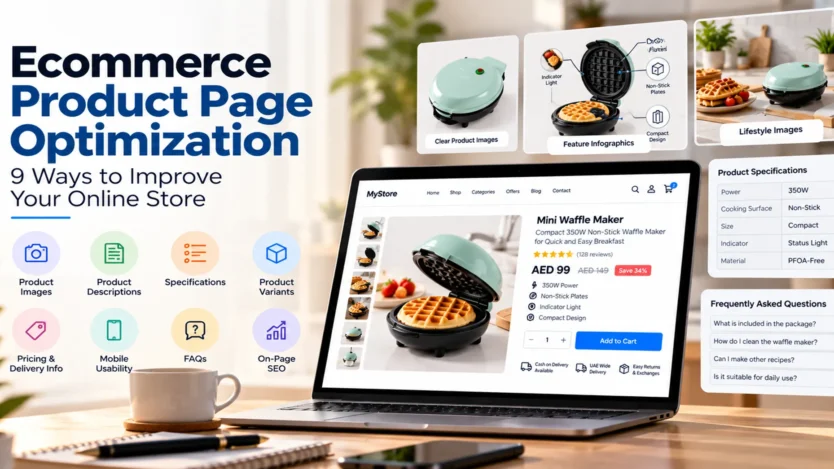
Attracting visitors to your ecommerce website is only the beginning.
Once customers reach a product page, they need enough information to understand the item, evaluate its suitability and decide whether to purchase.
A poorly structured product page can create unnecessary uncertainty.
Missing specifications, unclear photographs, confusing product variants and incomplete delivery information may leave customers with questions that your website should already answer.
The good news is that improving product presentation does not always require rebuilding your entire ecommerce store.
Targeted improvements to your product pages can create a clearer and more professional shopping experience.
Here are nine practical areas worth reviewing.
1. Write Clear and Descriptive Product Titles
Your product title should identify the item accurately.
Avoid relying entirely on generic titles such as “Amazing Kitchen Gadget” or “Premium Smart Device.”
Instead, include important product characteristics when relevant.
Example:
Generic title: Portable Blender
Improved title: Portable Rechargeable Blender – 6-Blade USB-C Model
The second title gives customers more useful information before they open the product page.
However, include only specifications that accurately describe the actual product.
2. Use Professional Product Images
Customers cannot physically examine a product when shopping online.
Your product images therefore play an important role in communicating its appearance, features and intended use.
A useful product image collection may include:
- A clean main product image.
- Multiple viewing angles.
- Close-ups of important features.
- Dimensions and size information.
- Lifestyle images showing appropriate use.
- Feature and specification infographics.
Product photography should do more than make an item look attractive.
It should help customers understand what they are buying.
Avoid displaying accessories, functions or materials that are not included in the actual offer.
Need stronger creatives for your products?
Choose a low-risk starter pack, a complete single-product sales pack or a three-product store bundle.
- Product-page images
- Static Meta ad creatives
- Shopify product descriptions
- Single or multi-product options
3. Write Product Descriptions That Answer Customer Questions
A useful product description should explain what the product does, how it is used and what customers should expect.
Avoid filling descriptions with repetitive promotional language.
Instead, focus on relevant features and practical information.
For example, when describing a mini waffle maker, customers may want to know:
- Its dimensions.
- Electrical requirements.
- Cooking surface.
- Indicator functions.
- Cleaning instructions.
- Intended use.
These details are more useful than a description that repeatedly calls the product innovative or premium without explaining its actual characteristics.
Include important limitations where relevant.
4. Organize Product Specifications
Technical details can become difficult to read when placed inside long paragraphs.
A structured specification table provides a clearer presentation.
For example:
| Specification | Example |
|---|---|
| Product type | Mini waffle maker |
| Power | 350W |
| Cooking surface | Non-stick |
| Indicator | Status light |
| Design | Compact |
Specification tables are especially helpful for electronics, appliances, fitness equipment and products available in several sizes or configurations.
Always verify technical information against the actual supplied product before publication.
5. Make Product Variants Easy to Understand
If your product is available in different sizes, colors or models, customers should be able to identify the appropriate option before adding it to their cart.
Use clear variant labels and accurate product imagery.
For size-dependent products, consider including a measurement guide.
Confusing product variants may lead to incorrect orders, unnecessary exchanges and dissatisfied customers.
6. Display Price and Delivery Information Clearly
Customers should not need to search multiple pages to understand basic purchase conditions.
Important information may include:
- Product price.
- Available payment methods.
- Delivery charges.
- Delivery coverage.
- Estimated delivery timeframe.
- Applicable return and exchange conditions.
For ecommerce businesses operating in the UAE, clarity around delivery fees and cash-on-delivery availability can also reduce unnecessary pre-purchase enquiries.
Delivery estimates should reflect actual fulfilment arrangements.
7. Improve Mobile Product Page Design
A product page may look professional on a desktop computer but become difficult to navigate on a smartphone.
Review the mobile shopping experience carefully.
Check whether:
- Images display correctly.
- Text remains readable.
- Product variants are easy to select.
- Pricing is clearly visible.
- Buttons work properly.
- Important information is accessible.
- Navigation remains straightforward.
Customers should be able to examine a product, select the appropriate option and proceed toward checkout without unnecessary difficulty.
8. Add Useful Product FAQs
A frequently asked questions section can address concerns that may not fit naturally into the main description.
For example:
Does the product require assembly?
Explain whether assembly is required and what is involved.
What is included in the package?
Clearly identify the supplied accessories and components.
Is the product compatible with my device?
Provide relevant compatibility details when applicable.
How should the product be cleaned?
Include appropriate care instructions.
FAQs should address genuine product-related questions rather than repeat promotional statements.
9. Apply Basic On-Page SEO
Product page optimization should also consider how search engines understand your content.
Start with the following elements:
Descriptive SEO Titles
Use a page title that accurately identifies the product.
Search-Friendly URLs
Keep product URLs readable and relevant to the actual item.
Original Product Descriptions
Write useful descriptions based on accurate product information rather than relying exclusively on generic supplier content.
Organized Headings
Use headings to structure descriptions, specifications and frequently asked questions.
Image Alt Text
Add descriptive alternative text that explains the actual image content.
Product Structured Data
Use appropriate structured data when supported by your ecommerce platform and ensure it accurately represents the product.
Avoid excessive keyword repetition.
The priority should be helping customers understand your product clearly.
Frequently Asked Questions
Do professional product images guarantee more sales?
No. Product images improve presentation, but purchasing decisions also depend on pricing, demand, product suitability, customer trust and delivery arrangements.
How many product images should an ecommerce page contain?
There is no universal number. Include enough images to explain the product’s appearance, features and important details without unnecessary repetition.
Should every product have a unique description?
Original descriptions are useful because they allow you to explain each product’s actual characteristics rather than relying exclusively on generic supplier information.
Can product pages be improved without changing ecommerce platforms?
Yes. Many improvements involve imagery, content, layout and product information rather than replacing the ecommerce platform.
Improve Your Product Presentation with Tradepoint Digital
A professional product page should help customers understand what they are purchasing.
At Tradepoint Digital, we help ecommerce businesses improve product presentation through:
- Product titles and descriptions.
- Professional product imagery.
- Product feature infographics.
- Organized specifications.
- Product category organization.
- Shopify and WooCommerce product listings.
Whether you are launching a new ecommerce website or improving an existing product catalog, we can help you present your products in a clear and professional format.
Discuss your product listing and creative requirements with Tradepoint Digital.