Introduction
In the world of online selling, payment gateways play a critical role in enabling secure and seamless transactions. Without a reliable payment system, an eCommerce business cannot function effectively.
Understanding how payment gateways work helps business owners choose the right solution, improve customer trust, and increase successful transactions.
💳 What Is a Payment Gateway?
A payment gateway is a technology that securely processes online payments between a customer and a business. It acts as a bridge between your website and the financial institutions involved in the transaction.
It ensures that sensitive information such as card details is encrypted and transmitted securely.
⚙️ How a Payment Gateway Works
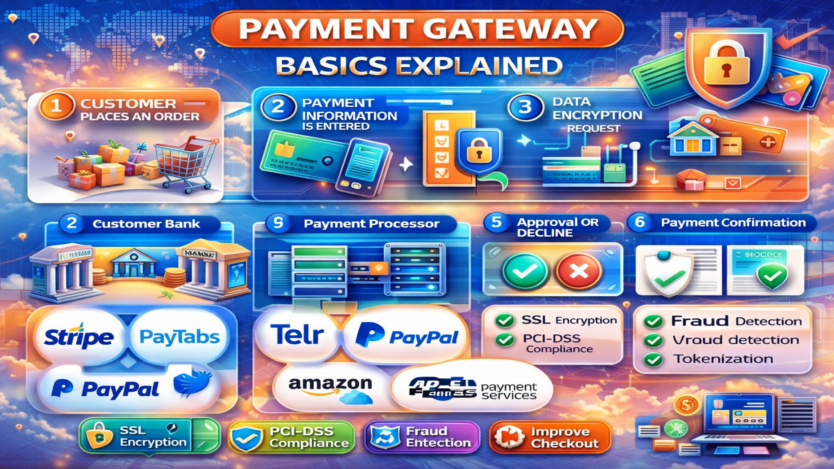
1️⃣ Customer Places an Order
The customer selects products and proceeds to checkout.
2️⃣ Payment Information Is Entered
The customer enters payment details such as:
- Credit/Debit card
- Digital wallet
- Other payment methods
3️⃣ Data Encryption
The payment gateway encrypts the data to protect sensitive information.
4️⃣ Authorization Request
The encrypted data is sent to:
- Payment processor
- Customer’s bank
The bank verifies if funds are available.
5️⃣ Approval or Decline
- If approved → transaction proceeds
- If declined → payment fails
6️⃣ Payment Confirmation
The customer receives confirmation, and the business processes the order.
🔑 Key Components of a Payment Gateway
- Payment Gateway → Handles transaction data
- Payment Processor → Communicates with banks
- Merchant Account → Receives funds
- Customer Bank → Approves or declines payment
💰 Types of Payment Gateways
🌐 1. Hosted Payment Gateways
Customers are redirected to a secure payment page.
Examples: PayPal, Stripe Checkout
Pros:
✔ Easy to set up
✔ High security
Cons:
✖ Redirects customers away from your site
⚙️ 2. Integrated Payment Gateways
Payments are processed directly on your website.
Pros:
✔ Better user experience
✔ Full control
Cons:
✖ Requires more setup and security compliance
🔐 3. Self-Hosted Payment Gateways
Customer enters details on your site, but processing happens externally.
🌍 Popular Payment Gateways (UAE & Global)
- Stripe
- PayTabs
- Telr
- PayPal
- Amazon Payment Services
🔒 Security Features of Payment Gateways
Security is essential for online payments.
Key Features:
- SSL encryption
- PCI-DSS compliance
- Fraud detection systems
- Tokenization
🎯 Why Payment Gateways Are Important
- Enable online transactions
- Build customer trust
- Reduce payment failures
- Improve checkout experience
- Support multiple payment methods
⚠️ Common Payment Gateway Mistakes
- Offering limited payment options
- Choosing unreliable providers
- Ignoring transaction fees
- Poor integration
- Lack of security measures
📈 Tips for Choosing the Right Payment Gateway
- Check transaction fees
- Ensure UAE compatibility
- Support multiple currencies
- Look for easy integration
- Prioritize security features
🚀 Best Practices
- Offer multiple payment options
- Optimize checkout process
- Ensure mobile-friendly payments
- Test payment flow regularly
- Display trust badges
Conclusion
Payment gateways are the backbone of any online store. A secure, fast, and reliable payment system ensures smooth transactions, builds customer confidence, and directly impacts your business success.
Choosing the right gateway and implementing it properly can significantly improve your conversion rates and overall user experience.
Need Help Setting Up Payment Gateways?
At Tradepoint Digital, we help businesses:
- Integrate payment gateways
- Optimize checkout systems
- Ensure secure transactions
- Improve conversion rates
👉 Get in touch today to set up the perfect payment system for your online store.